Sour cocktails are among the best-known drinks in the world of mixology. Appreciated by both bartenders and cocktail enthusiasts, they are renowned for their refreshing balance of spirit, lemon juice and sugar.
But what exactly is a Sour cocktail, and where does this famous family of cocktails come from?
History and Definition of the Sour Cocktail
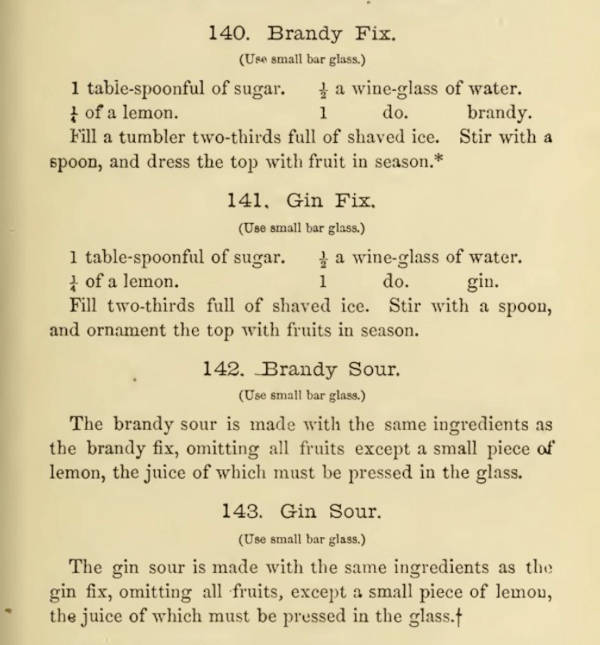
To understand what defines a Sour cocktail, we must go back to 1862, when Jerry Thomas, widely regarded as the father of modern mixology, published the first recipes in The Bar-Tender's Guide: How to Mix Drinks. This landmark book established many of the conventions that still define classic cocktails today.
Among the recipes published were two iconic examples: the Gin Sour and the Brandy Sour.
The 1887 edition of The Bar-Tender's Guide contains the definitive versions of the Gin Sour and Brandy Sour, while also introducing the Whiskey Sour, Jersey Sour and Egg Sour. These recipes established the historical foundation of what we now recognize as the classic Sour cocktail.
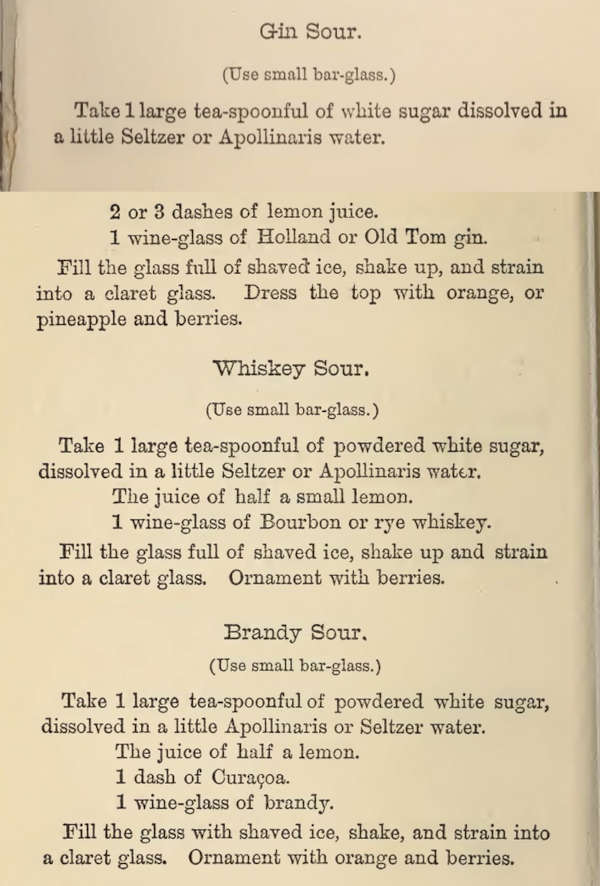
From these historical sources, a Sour cocktail can be defined as a drink consisting primarily of a spirit, fresh lemon juice and sugar, shaken with ice, strained into a glass and garnished with fruit.
One detail deserves particular attention: the garnish.
Although often omitted today, fresh fruit was historically an integral part of the Sour family. Throughout the nineteenth century, numerous Sour recipes were published with carefully selected fruit garnishes. Jerry Thomas himself recommended orange, pineapple and seasonal berries for both his Gin Sour and Brandy Sour, creating an attractive garnish that also complemented the drink's flavours.
From a historical perspective, fresh fruit is therefore not merely decorative—it is part of the identity of the Sour cocktail.
How to Make a Sour Cocktail
Making a Sour cocktail is remarkably simple.
Shake together a spirit, fresh lemon juice and simple syrup with ice, strain into the appropriate glass and garnish with fresh fruit.
For a spirit bottled at 40% ABV, I personally recommend the following proportions:
- 4/6 spirit
- 1/6 fresh lemon juice
- 1/6 simple syrup
For a generous 3 fl oz cocktail, this corresponds to:
- 2 fl oz spirit
- 0.5 fl oz fresh lemon juice
- 0.5 fl oz simple syrup
This formula allows you to prepare the classic Gin Sour and Brandy Sour described by Jerry Thomas, but also countless variations such as the Whisky Sour, Rum Sour, Vodka Sour, Tequila Sour, or even a Pastis Sour.
Two of today's most famous examples are undoubtedly the Pisco Sour and the Amaretto Sour.
Sours can also be prepared with beverages of lower alcoholic strength, such as beer, wine or fortified wine, as well as stronger spirits and liqueurs including Chartreuse or absinthe. In such cases, the proportions naturally need to be adjusted according to the alcohol content and flavour profile of the base ingredient.
More than 160 years after Jerry Thomas published his first Sour recipes, the formula remains as successful as ever. The balance between spirit, citrus and sugar continues to produce cocktails that are approachable, refreshing and remarkably versatile.