The question of whether a Dry Martini should contain aromatic bitters may seem like a matter of personal preference today. However, the earliest documented recipes tell a more interesting story. In my historical research into the Dry Martini, I found that the cocktail was not always prepared the way it is commonly made today, and that aromatic bitters were present in some of its earliest known recipes. So, should bitters really be part of a Dry Martini? To answer that question, we need to look closely at the cocktail’s early history and the recipes that shaped it.
History of the Dry Martini
The Dry Martini was first published under that name, at least as far as I have been able to trace, in 1904, in the second edition of American Bar: English and American Drinks, written by Frank Newman, a bartender who worked in Paris, notably at the former Grand Hotel near the Opéra.
The Dry Martini, however, can be traced back further, as similar recipes had already been published as early as 1895 under different names, including the Racquet Club Cocktail.
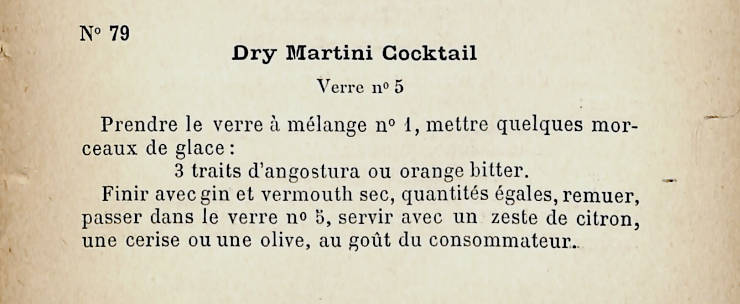
As you can see, Frank Newman’s recipe contained gin, dry vermouth, and Angostura or orange bitters, along with a lemon twist that was squeezed over the drink.
Later, during the 1900s, Dry Martini recipes were published without aromatic bitters, consisting simply of gin and dry vermouth. This is a version that remains quite common in bars today.
The first Dry Martini without aromatic bitters was published in 1908 in Jack’s Manual, written by American bartender Jacob Abraham Grohusko. However, Louis Muckensturm had already published a similar recipe in 1906, although under the name Pratt Cocktail, in his book Louis’ Mixed Drinks.
Bitters or Not Bitters? Further Back in the History
So, should a Dry Martini contain aromatic bitters or not? To understand the answer, we need to look further back into the history of the Dry Martini.
The Dry Martini is, in fact, the dry version of the Martini Cocktail, which was earlier known as the Martinez Cocktail. The Martini, or Martinez Cocktail, was made with gin, sweet vermouth, sugar, and aromatic bitters. As their names suggest, both the Martini Cocktail and the Martinez Cocktail belonged to the family of “cocktails” a category whose defining characteristic was the presence of aromatic bitters.
So the answer is yes: a genuine, authentic Dry Martini should theoretically contain aromatic bitters. However, omitting it is not necessarily a mistake; it is simply a more common variant.