The Gin Fizz, Tom Collins and John Collins are three remarkably similar cocktails. All three are made with gin, lemon juice, sugar and sparkling water, and are traditionally served in a glass without ice. So what actually distinguishes them? As you'll discover, it's all a matter of historical details.
Gin Fizz vs Tom Collins
Let's begin with the difference between a Gin Fizz and a Tom Collins.
A popular legend claims that the only difference between these two cocktails is the presence of ice cubes: a Gin Fizz is supposedly served without ice, while a Tom Collins is served over ice. In reality, this is simply incorrect.
To understand the true difference between a Gin Fizz and a Tom Collins, we need to return to the original sources. Both cocktails were first published in a cocktail book in 1876, in the second edition of Jerry Thomas's Bartenders Guide: How to Mix Drinks. Often referred to as the father of mixology, Jerry Thomas helped standardize many classic cocktail families, including the Fizzes and the Collinses.
After consulting this original edition, I was finally able to identify the authentic historical differences between the Gin Fizz and the Tom Collins.
Here are the original recipes.
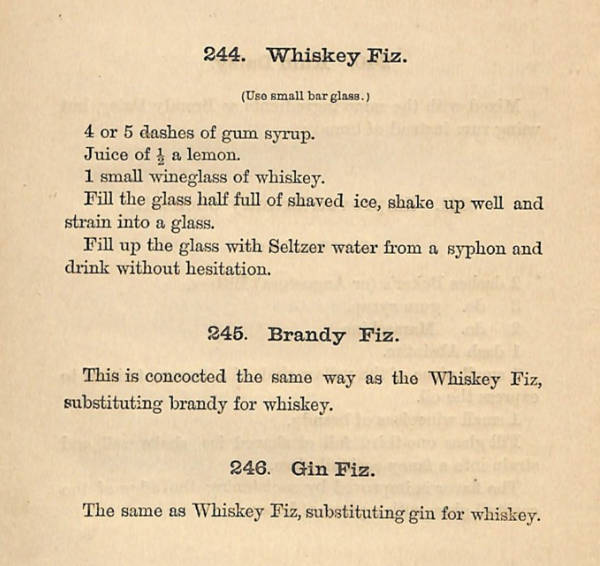
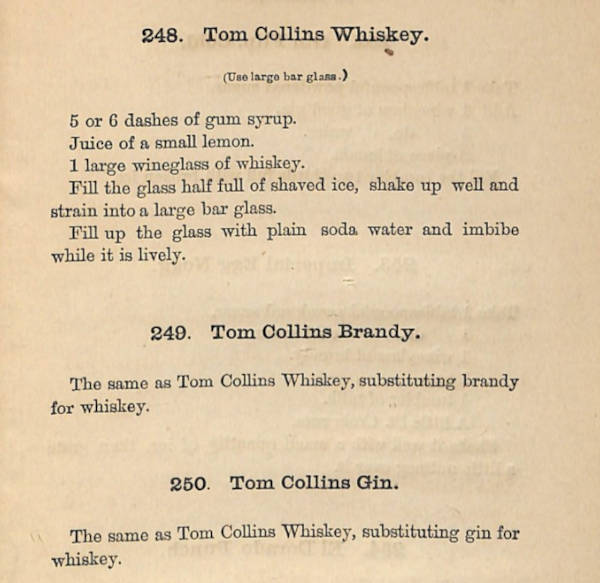
A careful examination of these recipes reveals that the Gin Fizz and the Tom Collins differ in only two ways:
- Serving size: the Tom Collins is prepared in a larger quantity than the Gin Fizz.
- The type of sparkling water: the Gin Fizz is topped with soda water from a siphon, while the Tom Collins is topped with natural sparkling water.
Contrary to what is often repeated today, the historical distinction between these cocktails has nothing to do with ice cubes, egg white or shaking technique. The real differences are simply the serving size and the type of sparkling water used.
It is also worth mentioning that a Gin Fizz made with egg white is actually called a Silver Gin Fizz, not simply a Gin Fizz.
Another interesting historical detail is that the cocktail we now call the Tom Collins was originally named Tom Collins Gin. In fact, Tom Collins referred to an entire family of cocktails that included Tom Collins Gin, Tom Collins Brandy, and Tom Collins Whiskey, as shown in Jerry Thomas's book.
This also explains why the Collins glass is taller than a standard tumbler. While the larger serving size remains one of the defining characteristics of a Collins today, the distinction between natural sparkling water and soda water has long since disappeared in modern bartending.
Tom Collins vs John Collins
A little more history helps explain the difference between the Tom Collins and the John Collins.
The first published recipe for the John Collins appeared in 1882 in Harry Johnson's New and Improved Bartender's Manual, written by the famous American bartender Harry Johnson.
Harry Johnson included both the Tom Collins and the John Collins in his manual. Comparing the two original recipes reveals that they differ by only one ingredient: the type of gin.
- The Tom Collins is made with Old Tom Gin.
- The John Collins is made with Holland Gin.
The Tom Collins recipe occupies two pages in the original book, but here is the original John Collins recipe.
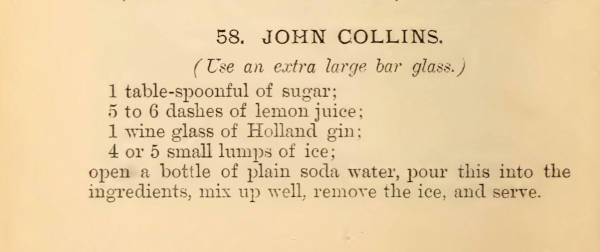
As you can see, the Gin Fizz, Tom Collins and John Collins are far closer than many modern sources suggest. Their historical differences are surprisingly subtle, yet they reveal how carefully nineteenth-century bartenders distinguished cocktail families.
The Special Cases of the Lime Gin Fizz and the Gin Rickey
Before concluding, two related cocktails deserve a brief mention.
The Lime Gin Fizz is simply a Gin Fizz prepared with lime juice instead of lemon juice.
The Gin Rickey goes one step further: it is essentially a Lime Gin Fizz without sugar.
These cocktails belong to closely related families but should not be confused with the original Gin Fizz, Tom Collins or John Collins as they were historically documented during the nineteenth century.